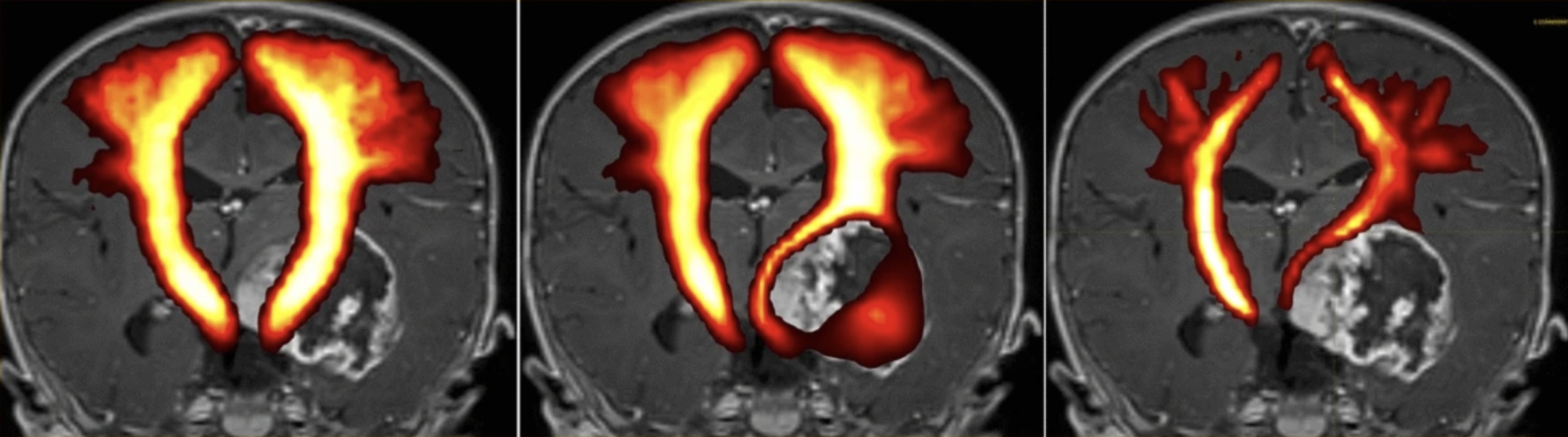
Tractfinder is a rapid and easy-to-use tool for segmenting key white matter tracts from clinical neuroimaging, including in cases with space-occupying lesions. It allows tracts subserving critical neurological functions—including sight, speech and gross motor function—to be identified accurately in individual patients using clinical magnetic resonance imaging (MRI). Key target application areas include neuroscience research, neurosurgical planning, intraoperative updates and evaluations of the health of white matter.
Tractfinder was developed by a team at University College London and Great Ormond Street Hospital for Children, led by Dr Jon Clayden. The core methodology has been peer-reviewed and published in the respected academic journal Human Brain Mapping, and further studies are ongoing.
An implementation is freely available for noncommercial research use only. If you are interested in licensing it for commercial purposes, please contact UCL Business Ltd or email contact@tractfinder.info. The tool does not yet have regulatory approval for clinical use, and should therefore be treated as a research method only.
A conventional T1-weighted or T2-weighted structural MRI scan and clinical diffusion-weighted MRI scan are required. The technique has much more modest requirements than many research techniques, with 12–20 direction acquisitions and a b-value of 1000 s/mm2 typically adequate.
No. Streamline tractography can produce compelling results, but has several drawbacks in practice: it generally requires significant expert input and some trial-and-error, takes a significant but variable amount of time to do well, and may need a more time-consuming scan for good results. Tractfinder circumvents manual region-of-interest placement and cannot be affected by tracking errors. However, streamline tractography can be straightforwardly performed within the segmented region, for contexts where that presentation is required.
No. While applications of AI in radiology are spreading rapidly, Tractfinder is not based on it. The algorithm is simple, deterministic and explainable, eliminating the possibility of “hallucination”.
If you're a researcher conducting a noncommercial study, then yes! An implementation is available for download via GitHub. For commercial applications a license is required, so please contact us.
Tractfinder was developed by Fiona Young, Jon Clayden, Chris Clark and Kristian Aquilina, a joint scientific and clinical team based at University College London and Great Ormond Street Hospital for Children. Many others have contributed to further work developing and proving it.
Not yet. We are working towards funding integration into existing workflows, and associated regulatory approval. If you could support this please get in touch.
Tractfinder is the subject of pending US and European patents.
We have published a new paper describing “Tractfinder-constrained tractography” (TcT), which allows streamline tractography to be straightforwardly performed within the tract region identified by Tractfinder. This retains the advantage of not having to place regions of interest manually, while allowing Tractfinder output to integrate cleanly with streamline-based workflows.
Abstracts using Tractfinder to reconstruct tracts in optic pathway glioma and paediatric brain tumour patients will be presented at the 2026 Annual Meeting of the International Society for Magnetic Resonance in Medicine in Cape Town, South Africa.
A new study by Sierhej et al. has been published in Human Brain Mapping, using Tractfinder in a multi-site reproducibility analysis.
A presentation on Tractfinder will be given at the inaugural conference of the International Society for Tractography in Bordeaux, France.
The cornerstone paper on Tractfinder has been published in Human Brain Mapping. This paper outlines the details of the methodology and performs several comparisons with streamline tractography and a deep learning–based alternative across different datasets.
We are grateful to have been awarded funding from Children with Cancer UK to support continued development of Tractfinder to help guide neurosurgery for children with brain tumours.
The first paper on Tractfinder has been published in the International Journal of Computer Assisted Radiology and Surgery, and will be presented at the upcoming CARS conference in Tokyo, Japan. This highlights the technique's application to neurosurgery, including in the presence of space-occupying lesions.